Friday, June 19, 2009

1 Corinthians 11:3 HEADSHIP OR LORDSHIP?

But I would have you know, that the head of every man is Christ; and the head of the woman is the man; and the head of Christ is God.

In Matthew 21:42, Jesus said, “Did ye never read in the scriptures, the stone which the builders rejected, the same is become the head of the corner: this is the Lord's doing, and it is marvelous in our eyes?”

Jesus is the head of the corner. That means he is the primary corner or angle. [1] The primary angle of a structure is one that directly connects with every other angle within the structure. This is a critical concept to grasp in understanding relationship roles between males and females within the Body of Christ. The Church of Christ is built of living stones[2] with Jesus Christ being the primary angle, the Chief Cornerstone.

A chief cornerstone is not a common stone. Research reveals that it is a capstone. Common structures do not have capstones. There is only one structure that does, and that is a pyramid. A pyramid is a foursquare[3] structure that has many angles (corners, cornerstones). A pyramid has an angle (cornerstone) at each of its four corners on every level, but it can have only one capstone. The primary angle, the capstone, is the chief cornerstone. The capstone has four corners from which the entire structure flows from and connects to.

The body of Christ is depicted as a pyramid that is built from the top down with Christ himself being the chief angle—the capstone—to which the entire structure is connected.

Every member of the body of Christ finds his or her source of and connection with life in Christ himself. The man Christ Jesus[4] is the only mediator between God and mankind. There is no other human mediator between individual believers and Christ himself. This is part of what the “Headship” of Christ consists of. As Christians, Christ is both our Head and our Lord, but his Headship is not to be confused with his Lordship.

It is common to hear the word “headship” used in regards to the relationship between men and women and most especially between husbands and wives, but to use the term headship synonymously with lordship in regards to any human relationship is heresy and blasphemy. Every Christian has only one Lord and that is the Lord Jesus Christ from whom the whole body originates and is jointly fit together and nourished.[5] It is no accident that the Headship of Christ is used in conjunction with building metaphors as seen in Colossians 2:18-19, Matthew 21:42, and in numerous Old Testament passages where the Messiah is referred to as the chief corner stone (capstone or angle).

Both his Headship and his Lordship entail authority. And although his Headship and Lordship are not identical, they are intrinsically linked. Separating the two would be as difficult as separating the soul and the spirit.[6] Careful study reveals that the Headship of Christ has more to do with origins and the construction of his Body—the Church—as a whole, while the Lordship of Christ has more to do with his leadership and guidance of believers individually.

The Headship of Christ in creation is an immutable fact. It is not something we choose to submit to or not. It just is. The Headship of Christ in salvation is also an immutable fact. There is no salvation apart from him. He is the source of all life. He is the resurrection and the life. Jesus did not come to show the way. He came to be the way. Christ is directly responsible for the act of his Headship in both creation and salvation. He participated in, and continues to participate in, the process of headship.[7] In addition to being an immutable fact, The Headship of Christ is also an ongoing, active process of salvation and the building of his Church. No human, therefore, can claim “headship.” Being called “the head” is not the same as “headship.”

The scripture that refers to the man as being the head of the woman[8] is a reference to the origins of man and woman at creation. It is a reference to the way in which they came into being, not a reference to an authority or submission structure within the marriage relationship.

The reference to God being the head of Christ is referring to his incarnation as a human—not to his Deity. As God, Jesus Christ does not need a God.[9] But although all the fullness of the godhead dwells in Jesus Christ bodily, as a human, Jesus needs God just as all humans do.[10] The difference being that Jesus did not need a redeemer, but he had to become exactly like us in order to redeem us.[11] And that has everything to do with the building of his Church.
In an earthly pyramid, the capstone is laid last, but the capstone of the living organism, which is the Church, of necessity, had to be in place first, because that is what all the rest of the structure originates from, receives nourishment from, and grows from.

Jesus Christ, THE WORD,[12] is the creator of all things, and he created both the man and the woman with his own hands. Mankind, both male and female, is a direct creation of God. The fact that woman came into being through the man does not make her an indirect, or secondary, creation of God. Jesus created her with his own hands as well. And she is, in every way—not just in her feminine aspects—created wholly in the image of God just as man is. There is no scripture that substantiates the teaching that males reflect only male aspects of image of God while females reflect only female aspects.

The creation of male and female and the marriage relationship are types of the creation of, and the mystical one flesh relationship between, Christ and his Church. Christ’s redemption and his Church was part of the cosmic plan from the foundation of the earth.[13] Although each human-being, individually, is a type of the triune godhead (one of the ways we are each created wholly in God’s image is that we are three-fold beings) the creation of the marriage relationship and the physical, mental, and emotional differences between the sexes has to do with the mystery of Christ and his Church, not to our being created in the image of God.[14] We see this in the “types” provided in the creation account.[15]

When God said, “It is not good that man should be alone,” he was giving us a type of the longing of Christ for his bride. The deep sleep that Adam fell into during the creation of his bride was a type of Christ dying for our sins (the Church could never have come into being without that).[16] His awaking out of sleep was a type of the resurrection of Christ. The fact that the bride was taken out of Adam’s flesh is a type of the creation of the church through the suffering of Christ’s flesh during his crucifixion. The woman being presented to the man was a type of, the human, Christ Jesus, presenting his bride to himself without spot or wrinkle (the human husband will not present his wife to Christ).[17] And Adam’s proclamation that the woman was bone of his bone and flesh of his flesh is a type of the Church which is Christ’s Body as well as his Bride. [18]

The fact that the woman was created from the flesh of the man (being a type of the creation of the Church through the suffering, death and resurrection of Christ) confers no authority upon human men over human women. This is a type, not a prescription for a bizarre, life-long, human role-play. The apostle wrote that the mystery of marriage has to do with the bone of my bone and flesh of my flesh relationship between Christ and his Church. And it remains a mystery. Humans simply cannot grasp or portray this mystical relationship in its fullness— We cannot flesh it out. It remains a mystical, completely voluntary, one flesh relationship, and men have been given no divine prescription of “headship/lordship over women. That privilege is reserved for Christ alone.

Only the Headship of Jesus Christ could bring us into being, and then redeem fallen mankind. If Christ is not our head, then we do not have life; we are not saved. We would have no access into the presence and power of God. Separation from the presence and power of God is the biblical definition of DEATH.[19]

Jesus builds his Church, one stone (soul) at a time, adding the cornerstones at each level, with himself being the chief cornerstone, the capstone—the primary angle. The scriptures tell us that women will be cornerstones as well as men.[20]

We are commanded to walk in Christ’s love with all people and most especially with our spouses. Christian men and women should reflect the love relationship between Christ and his Church by serving Christ, and that does entail serving one another, but all Christians are commanded to be subject to one another—not just wives to husbands. Husbands are required to submit to wives as well.[21]

Saying that the man is the head of the woman is not the same as saying the man has “headship over” the woman. Mankind has been given no authority that can remotely be referred to as “headship.” The 1 Corinthians reference to the man as the “head” of the woman is a direct reference to the manner of her creation and the great mystery having to do with Christ and his Church. It is not a reference to any authority/submission, “lordship,” structure between husbands and wives.


[1] Strong’s Greek Lexicon defines corner (#1137) as, an external or internal angle or corner
[2] 1 Peter 2:4, To whom coming, as unto a living stone, disallowed indeed of men, but chosen of God, and precious, 5: Ye also, as lively stones, are built up a spiritual house, an holy priesthood, to offer up spiritual sacrifices, acceptable to God by Jesus Christ. 6: Wherefore also it is contained in the scripture, Behold, I lay in Sion a chief corner stone, elect, precious: and he that believeth on him shall not be confounded.
[3] Revelation 21:16 “The city lieth foursquare”
[4] The terms “Son of Man” or “The man Christ Jesus,” always refer to Christ’s humanity as opposed to his Deity.
[5] Colossians 2:18
[6] 4:12 For the word of God is quick, and powerful, and sharper than any two edged sword, piercing even to the dividing asunder of soul and spirit, and of the joints and marrow, and is a discerner of the thoughts and intents of the heart.
[7] His Church continues to be built: Matthew 16:18 upon this rock I will build my church; and the gates of hell shall not prevail against it
[8] 1 Corinthians 11:4
[9] All the fullness of the godhead dwell in Jesus bodily. Colossians 2:9
[10] His most desolate hour was when he hung on the cross and the Father laid the sins of the world on him. That was when he cried Father, Father, why have you forsaken me? For God could not look on sin. Jesus tasted death for us when bore our sins. The work was “finished” while he yet hung on the cross. Before his physical death, for the first and only time in his life, Jesus was separated from the power and presence of his Father, and that is the biblical definition of death. We are wholly without excuse if we reject the salvation he provided.
[11] John 1:14, Hebrews 2:16-18
[12] John 1:1, Colossians 1:16, Hebrews 1:2,
[13] Revelation 13:8
[14] Ephesians 5:31-32
[15] Genesis 1:27, 2:18-24, Types prophetically foreshadow good things to come in regards to Christ’s redemption of our souls, bodies and the earth, but types have their limits. A type may reveal only one aspect of a truth but not all of it. For instance in under the old covenant, it took the sacrifice of two birds to illustrate different aspects of the one redeeming work of Jesus Christ on the cross (Leviticus 3:7). Hebrews 10:1a tells us that the Law of Moses was a shadow (a prophetic “type”) of good things to come
[16] Saints are frequently referred to, in scripture, as “sleeping” or “asleep.”
[17] Ephesians 5:25-27, the doctrine that husbands are mediators for their wives and will present them to God is utterly false. The passage in Ephesians is speaking of Christ presenting the bride—not the earthly husband. The view that husbands give account to God for the behavior of their wives presents numerous difficulties, not the least of which would be the question of which husband would present which wife in the case of more than one marriage, as the Bible does give instructions for biblical divorce and remarriage.
[18] Genesis 2:21-24, Ephesians 1:22-23 … the church, Which is his body, the fullness of him that filleth all in all.
[19] 2 Thessalonians 1:9
[20] Psalms 144:12 That our sons may be as plants grown up in their youth; that our daughters may be as corner stones, polished after the similitude of a palace:
[21] Ephesians 5:21

Saturday, June 13, 2009

Because of the Angels

1 Corinthians 11:10 says, “For this cause ought the woman to have power on her head because of the angels.”

It is generally inferred and more than implied that because the woman was deceived, and sinned first, that females are inherently more naïve, gullible, and prone to fall prey to seduction than males. And that because of this, her perpetual consequence this side of Heaven—for her personal protection and for the good of everyone else—is that from her birth to her death, she is to be placed under male authority. While it is the closing words of 1 Corinthians 11:10 that seem so mysterious—most scholars confess to being baffled by the portion that reads, “because of the angels”—a close look at the Greek makes it clear that the general understanding of the first part of the verse needs to be challenged.

When looking for answers, it is important to be certain that we are asking the right questions. And a good place to begin solving the mystery of 1 Corinthians 11:10, is to ask what it might be that womankind has in common with the angels. There is not much that humankind has in common with angels—either male or female—but womankind does have the distinction of having DECEPTION in common with angels. Was not the angel, Lucifer, deceived into thinking that he could be as God? The scriptures record that the highest ranking angel was deceived, sinned, and subsequently caused the fall of one third of all the angels who voluntarily chose to follow him into perdition. Hmmmm, sound familiar?

It is commonly assumed that, because Eve was deceived, all women are gullible and easily deceived, but does the fact that Lucifer was in deception, that he deceived himself into believing that he could be as God and successfully convinced one third of the angel population to follow him into perdition, mean that all angels are inherently gullible and must henceforth be placed “under authority?”

No, it does not. The angels that sinned are fallen without hope of redemption, but the angels that did not follow Lucifer in his rebellion still have liberty. They continue to exist as free moral agents, without stigma, who possess the power to obey or not to obey as do all women who are born again and have the Spirit of the Living God dwelling within them.

Then why does the Bible say that a woman must be under authority because of the angels?

The pure and simple truth is that the Bible says no such thing. The English Bible says that “For this cause ought the woman to have power on her head.” The phrase, “have power on her head,” is not synonymous with “under authority.” To understand what this means, we need to look at several words contained in this verse—have, power, and head.

The word “have,” in 1 Corinthians 11:10, can also be translated as “possess.” And indeed it is translated “possessed,” albeit in a negative sense, in Acts 8:7 and 16:16. But the negative connotation of the word in these verses has nothing to do with the word itself. The word “possess” has to do with ownership or control over. It has no inherent connotation of either good or evil in and of itself. The important thing to notice in 1 Corinthians 11:10, is that it is the woman who possesses the power that is on her head. There is no hermeneutical reason for assigning the power that the woman possesses to someone else.

The next logical question is, what kind of power does the woman possess? The word translated “power,” in 1 Corinthians 11, is also translated “liberty” in 1 Corinthians 8:9.

There is no logical reason—aside from the fact that it would blow patriarchal theology completely out of the water—that 1 Corinthians 11:10 could not be translated, “For this cause ought the woman to POSSESS LIBERTY on her head (the text does not say over her head—this is significant). The liberty, or authority, belongs to the woman. This means that the woman is in personal possession of liberty and authority over her own person. The Bible (both Old and New Testament) is full of examples that the word “head” is used interchangeably to mean several things, either “person or self,” a portion of our anatomy—a “physical head,” or “authority over” (Matthew 5:36, 14:8, 21:42 ), and a new shade of meaning is added in the New Testament, that of nourisher and edifier (Ephesians 4:15-16). But the meaning of “head” in 1 Corinthians 11:10 is universally recognized as referring to the person of the woman.

The marriage relationship, indeed the very creation of the sexes, Is a type of the mystical union and completely voluntary love relationship existing between Christ and his Church. It is not a type of the authority submission structure within the godhead, or designed to be a lifelong role-play between corrupt human beings in an utterly vain attempt to illustrate such a mystery to the world.

Excepting Almighty God and legitimate legal authorities, it is the woman herself who possesses liberty—authority—over her own person. And the Bible says that this is because of the angels, but which angels are being referred to in this verse? The angels referenced, in 1 Corinthians 11:10, are not the fallen angels but rather the angels who did not fall, the angels who, in spite of Lucifer’s personal deception and sin, and the fall of one third of their fellow angels, remain to this day—free moral agents. The angels that fell could not be redeemed, but the angels who remained loyal to God continue to possess personal authority and liberty over their own persons, liberty to choose or not to choose personal accountability and obedience to God. Angels are not considered inherently gullible or penalized because one of their own was deceived. Neither are redeemed females penalized, by being bound under male authority, because the first woman was deceived.

Friday, March 13, 2009

Complementarians Not Traditionalists? Hogwash!

Complementarian leaders claim they are not traditionalists when it comes to gender roles, however, I have been reading reams of their literature and can find little if anything in them to back that claim.

In the late 1980's The Council on Biblical Manhood and Womanhood (CBMW) was founded. They released The Danvers Statement, and in order to soften the true nature of their hard line, traditionalist, theology in regards to gender roles, created the warm, fuzzy moniker "Complementarian" to describe themselves.

The truth is, complementarians are just as rigid, if not more so, than traditionalists. And there is only one major difference, that I can find, between evangelical traditionalists and complementarians in regards to gender roles, and that is that most traditionalists teach that female subordination is a result of the Fall while complementarians, along with fundamentalist traditionalists, teach that female subordination was mandated as part of the original creation.

So what is the real difference between the two? In practical application, virtually nothing. But it is worthwhile to note that evangelical traditionalists now recognize that their theology has always provided a loophole for New Testament Christians in removing the yoke of subordination from women while fundamentalist complementarian theology neatly plugs the hole. Since the late 1980's, evangelicals have been jumping the traditional ship by the boatloads and climbing on board the fundamentalist complementarian bandwagon in regards to gender issues.

Before 1987, most leading evangelical leaders, churches and seminaries were traditional, including the influential Moody Bible Institute. Another example is Beverly LaHaye, president of Concerned Women for America and wife of bestselling author, Tim LaHaye. LaHaye took the traditional position in her 1984 book, The Restless Woman where she carefully explained that males and females were originally created equal but that the Fall changed all that resulting in the ongoing subordination of women in rigidly prescribed "roles" for them in marriage, church, and society. Today, it appears LaHaye has traded traditionalism for complementarianism. She currently serves on the Board of Reference for the "Complementary" CBMW.

Complementary? Who gets complemented? Let's face it, in both complementarian theology and practice, it is the female--always--who complements the male; she completes him, she assists him, her calling is to help him fulfill his calling, etc., etc., so on and so forth, ad infinitum.

Putting the dynamics of such a relationship in perspective isn't very difficult. Take steak and Lea and Perrin's for example, what complements what? Does the steak complement the sauce? Or is it the other way around? What about French-fries and catsup? Do the French-fries complement the catsup?

Of course not! And in a "complementarian" marriage, the wife is always the sauce or the catsup, never the steak or the french-fries. So where is the "complementary" aspect? In practice, it does not exist. Why? Because in practice, in a true "complementarian" relationship, no one should be the steak or the French-fries, and no one should be the mere complementary condiment "completing" the main course.

In view of the uncomplementary nature of complementarian theology, I refuse to any longer refer to them by a title which I believe is deliberately deceptive. Therefore, I have created a title which I believe more accurately describes complementarians and all others of their ilk. From henceforth, I refer to all fundamental and evangelical male supremists as, TRADITIONAL "ROLE" RELIGIONISTS--TRR'S for short

Tuesday, March 10, 2009

Twelve Dollar Tuna

I was at Los Angeles International airport, and I was hungry. No problem, I’ll grab a little something while I wait for my plane. That little something turned out to be a tuna sandwich and a drink that came to a total of almost $13! Although I was appalled at what I was asked to pay for that sandwich, I had to admit that it was the best tuna sandwich I had ever tasted. So I took note of the ingredients and added a new recipe to my personal cookbook, Twelve Dollar Tuna. It was an instant hit at home as well, and my husband now takes Twelve Dollar Tuna for lunch at least one day a week.

Butch and I have always enjoyed a very relaxed and peaceful life together. We are extremely compatible and in agreement concerning many things that might otherwise cause quite a bit of friction in our relationship. One thing that could have been a real issue at the beginning of our marriage was my job—which I was willing to give up if necessary. I was required to travel extensively. I was usually gone a few weeks out of every month. The last eight weeks I worked for the company, I was on the road for six of them—all of this with the agreement of my husband. In fact, it was Butch who initially encouraged me to accept the traveling position only one week after our wedding. We both felt, though we had no idea why, that it was the Lord’s will for me to accept the position. We now know why and are eternally grateful that we were obedient to the Spirit of the Lord concerning my job.

Butch had no issues with taking care of the house and taking care of himself, while I was on the road. And when I was not traveling, although I cooked most of our meals, he still insisted on making his own lunch every morning. I was more than willing to make it for him, but he would not hear of it. So, when I was home, our mornings fell into the pleasant routine of getting up, drinking our coffee, reading our Bibles, visiting with one another for a few minutes, and then Butch would prepare his lunch for the day while I got ready for my day at the office.

Things have changed quite a bit at our house since those early days when we both worked outside the home. We both still work, but adjusting to my working at home rather than leaving for the office every day has been quite a challenge for us both.

Butch’s schedule has changed significantly as well. He now gets up literally in the middle of night to get ready for work. Most days I get up with him. We enjoy spending time together even if it is in the middle of the night, but sometimes I stay in bed. It depends upon whether I have gone to bed early or burned the midnight oil working on a book project. Butch’s schedule is set, but by mutual agreement, mine is not. That works for us. And things usually flow fairly smoothly around our house.

Well, the introduction of Twelve Dollar Tuna into our lives caused a slight bump in the road, but, thankfully, we ironed it out quickly and it helped clarified our thinking on the Fried Egg Sandwich issue at the same time. We have discussed the Fried Egg Sandwich scenario (mentioned in an earlier chapter) many times and both agree that it is not only not for us, but we believed it to be sinful and unbiblical as well.

As I said, Butch loves my Twelve Dollar Tuna and takes it for lunch at least once a week. It is my special gift to him—although he did not know that until recently.

At this point I know some will think, “Tuna salad, that’s no special gift! That is just preparing your husband’s lunch and sending food to work with him that he likes.” But I disagree. And knowing Butch, I believe I can safely say he disagrees as well. My husband likes all kinds of food. And for lunch he is quite happy with many kinds of different sandwiches. He likes bologna sandwiches, ham sandwiches, turkey sandwiches and chicken sandwiches. He loves to buy chicken gizzards on Fridays and burritos on Wednesdays. He is not at all difficult to please when it comes to food. But my Twelve Dollar Tuna especially pleases him, and that makes me feel good.

Well, it turns out my easy to please husband, who has always insisted on making his own lunch, does not know how to make Twelve Dollar Tuna, and he is not the least bit interested in learning. He has watched me make it and knows that it requires a bit more preparation than he wants to put into it. Butch enjoys the sandwiches but does not require me to make them. I make them anyway. It’s a personal thing for me, one of those little things I enjoy doing for my husband. However, Butch wasn’t aware that making Twelve Dollar Tuna for his lunches was a special labor of love.

Late one night, forgetting the next day was a Twelve Dollar Tuna day, I forgot to make it and dragged my weary self into bed. When Butch’s alarm went off at 2am, I had barely been asleep three hours. Being awakened by his alarm didn’t bother me, it happens all the time, but as Butch should have known, I had no intention of getting up. He knows I don’t if I work late. If I am still sleeping when Butch wakes up, he just gets up, goes to work, and we see each other later. This particular morning, though, he had no clue that I had barely been asleep a few hours. All he saw was that I was awake when the alarm went off. He must have woke up hungry and it being Twelve Dollar Tuna day, asked me, very sweetly of course, if I was going to get up and make it for him. It was so out of character for Butch to ask me to get out of bed in the middle of the night and prepare food for him that I should have realized he believed I was wide awake (that would not have been unusual). My answer was a less than Christ-like, “Are you kidding?”

I did feel badly, though, about forgetting to make his Twelve Dollar Tuna as well as for my poor attitude when he asked me about making it (even if it was the middle of the night!) and I asked him about it later. When he told me he had not taken anything for lunch that day, my guilty feelings really kicked in, and I worked myself into quite a lather imagining that he had gone lunch-less that day just to spite me for not making his Twelve Dollar Tuna. Now Butch is not like that, and I should have known it, but my conscience was killing me over my poor attitude—which didn’t appear to be improving any, and I accused him of being manipulative and trying to control me through guilt. I was furious that he would lose respect for our mutual agreement to keep different sleep/wake schedules and to stoop so low in order to manipulate me. I declared that I would get up in the middle of the night and make his Twelve Dollar Tuna sandwiches if he insisted, but that it would no longer be a labor of love but rather an act of compliance, nothing more. I told him his Twelve Dollar Tuna would really be Fried Egg Sandwiches.

But worse than that, not only would my Twelve Dollar Tuna have been turned into
Fried Egg Sandwiches, but the reality of our uniquely balanced, completely voluntary, love relationship would have changed as well, on both sides. Neither of us wanted that.

Well, I have a wonderful husband who patiently explained what I should have known without being reminded, that he honestly believed I had been awake and ready to get up with him, as I frequently am. On many occasions he had witnessed me cheerfully making Twelve Dollar Tuna at 3am, and he, having no idea what time I had actually come to bed that night, thought this was just another one of those early mornings I would be up with him. I sincerely repented for my terrible attitude and begged his forgiveness. He forgave me and assured me that he could never enjoy a bite of Twelve Dollar Tuna if it was, in reality, a Fried Egg Sandwich .

.

When Twelve Dollar Tuna turns into Fried Egg Sandwiches, something has gone seriously awry in any marriage relationship. The mystical, Heavenly, love union that mysteriously represents that of Christ and His Church ceases to be and is replaced by an earthy compliance that should be as unacceptable to any husband or wife as it is to Christ.

Our God compels us to do nothing and certainly is not interested in our mere compliance. He wants only Twelve Dollar Tuna—from both his sons and his daughters. He will spew the Fried Egg Sandwiches out of his mouth.

Saturday, March 07, 2009

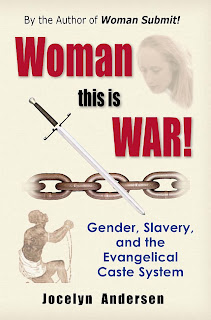
GENDER, SLAVERY, & The EVANGELICAL CASTE SYSTEM


In reading, Quiverfull: Inside the Christian Patriarchy Movement, by Kathryn Joyce, I was fascinated that a self-described secular feminist and professing non-believer could write with such clarity and sensitivity on the Patriarchy Movement that has made major inroads within Fundamental and Evangelical denominations during the past few decades.

My next book, GENDER, SLAVERY, & the EVANGELICAL CASTE SYSTEM, (release date to be announced) has led me into extensive personal research into the Patriarchy movement, so I felt I was in a unique position to judge Joyce's research and conclusions. I found her research credible and that her conclusions about the movement closely aligned with mine.

Although she and I would most likely not see eye to eye in regards to the abortion controversy, I believe we are very much in harmony regarding many, if not most, aspects of the gender issue. And though the Patriarchy Movement may be only a possible threat to secular women's rights, it is a very real and present impediment to evangelical women's inalienable and God-given rights.

As I have already stated in my book, WOMAN SUBMIT!, I believe the Patriarchal theology most Fundamentalist and Evangelical Christians adhere to is a threat to the physical safety and emotional well being of many Christian women. I do not believe domestic abuse or domestic violence will ever be resolved within the church until the gender issue is properly addressed.

I may not agree with everything contained within the pages of, QUIVERFULL..., but I certainly do recommend the book. I feel it was written out of a sense of valid concern and with integrity. I feel the facts concerning the Patriarchy Movement were presented fairly and accurately.

I was impressed with the lack of malice in Joyce's writing and thrilled to see the subject of Christian Patriarchy getting the attention it so desperately needs and deserves. As a Bible believing Christian, I am appreciative of the graciousness Joyce displayed towards the people and the movement she wrote about—a graciousness that I am certain will not be reciprocated by those who will feel threatened by her message.

Wednesday, March 04, 2009

Biblical Man Wants Fried Egg Sandwich

“If I wake up at 3am, and tell my wife I want a fried egg sandwich, then she has to get up and make it for me…”

As I had recently had my head kicked in—literally—and the only clue given as to why, had to do with not having breakfast ready when my violent husband expected it, I was, understandably, not too sympathetic with what I was hearing from our assistant pastor at our Sunday night church service. But my heart did go out to his wife as he was sharing his views on what he believed constituted a biblical marriage relationship. He unashamedly ruled supreme in their home, deciding every matter, to the point where he dictated whether or not his wife could even get her nails done on any given day.

There was no question about her submission to his “Servant Leadership.” And because his wife submitted meekly to his bullying, he was pleased to present her to the church as a prime example of “Biblical Womanhood.” Even so, I was convinced that describing her as, “scared to death of him,” would have come closer to the truth.

When she was awakened in the middle of the night, out of a peaceful slumber, and forced out of bed to cook her husband that fried egg sandwich, did she get up willingly, or did she feel like the live-in body servant he obviously believed she was? Did she joyfully and lovingly make that sandwich and present it to him while enjoying a few moments of companionable fellowship with her spouse, or did she quietly, and, to all outward appearances, serenely set it on the table all the while thinking, ‘There, I hope you choke on it!’?

When he received that sandwich, did he eat it with the satisfaction of believing that all was as it should be in his world? Would it have bothered him at all to know that his wife did not feel the same way? And if his wife felt resentful and used at having her rest disturbed for no other reason than to satisfy his craving for a midnight snack, would it have been a legitimate expression of “Biblical Manhood” for him to have blithely enjoyed that snack without giving a second thought to her feelings?

Are the expressions “Biblical Manhood” and “Biblical Womanhood” even biblical?

Hold these thoughts while we explore the dynamics of the God-given differences between the sexes, the biblical appropriateness or non-appropriateness of assigning hard and fast gender roles to men and women, and the very real gender war that began in the garden and is raging hotter than ever today.

Friday, January 16, 2009

Saddleback Church, Abuse and Divorce

In a recent audio teaching posted to Rick Warren’s Saddleback Church website, Tom Holladay, one of their teaching pastors, stressed that the ministry at Saddleback does recommend separation in abuse cases but never divorce. He was emphatic that the Bible does not permit divorce in cases of domestic abuse.

I disagree with that opinion. The Bible Does Permit Divorce In Cases of Domestic Abuse, and I refer my readers to Barbara Roberts excellent book, Not Under Bondage: Biblical Divorce for Abuse, Adultery, and Desertion. Roberts presents a strong, articulate, and most of all biblical argument that God does indeed permit divorce in cases of domestic abuse.

Saddleback Church is dishing up typical evangelical fare on the subject of domestic abuse and domestic violence. In and of itself that is not surprising. But has it occurred to anyone to ask why a pastor who is on the extremely liberal end of the Southern Baptist spectrum, to the point of being denounced as heretical by many evangelicals, tows the traditional line, to the hilt, when it comes to domestic abuse and divorce?

Could the reason be that Saddleback Church also tows the traditional line in regards to the doctrine of male authority and female submission? Male authority which can still be maintained in a controlled separation but is seriously threatened when a woman is given leeway of any kind, for whatever reason, in ceasing to submit to an abusive husband by divorcing him? Is it any wonder then, that Holladay also inserted submission theology into his teaching on the subject of abuse by subtly reminding women of their duty to maintain a submissive attitude towards their husbands, although he tempers the inclusion by acceding that tolerating abuse is not a proper example of displaying an attitude of submission.

Nancy Leigh DeMoss, author and council member of The Council on Biblical Manhood and Womanhood (CBMW), does the same in her book, Lies Women Believe. Her advice to women in abusive marriages is to leave if they have to, but never, under any circumstances, consider divorce. If a separation must take place, counsels DeMoss, then during the separation, an abused wife is to maintain an attitude of reverence towards her abusive husband’s God-given position of authority over her—which, according to DeMoss, is not abrogated by the abuse.

Thankfully, Holladay did not go as far as Bruce Ware did in his presentation to Denton Bible Church, last year, by suggesting that women often bring abuse upon themselves by not submitting to their husbands.

No matter who is discussing abuse, either victims or church leadership, it seems the subject of submission always manages to slip into the conversation. We just cannot seem to discuss the one without discussing the other. Many victims know that abuse is the extreme end result of the doctrine of female subordination, while supporters of the doctrine acknowledge the fact that it must be carefully controlled or disaster can and often does come of it.

In the audio entitled, "What do I do if I am miserable in my marriage?" Holladay also gives a contradictory message to wives experiencing domestic abuse. While on the one hand, he clalims to believe that women are not required to submit to abuse, on the other he defines abuse as being beaten regularly (He stated that he does not consider a husband shoving his wife once as a good reason to separate). So by his own definition, he does expect wives to submit to verbal, emotional, economic, and even a certain amount of physical violence. I would ask Mr. Holladay how many beatings would have to take place in order to qualify as regularly?

Beaten regularly? What a horror of a life! Thank God that the Bible, along with the judicial powers that be, and the laws of the land, are not in agreement with the callous opinions of Tom Holladay and Saddleback church. God gives his blue print for deliverance from the evil man in Proverbs chapter two (see chapter five of Woman Submit! Christians & Domestic Violence, for a detailed study of that blueprint). There is no loophole in that chapter excepting abusive husbands or restricting abused wives from that deliverance. And I would call Holladay’s attention to the fact that a woman may not survive even the first beating. If she does survive it, what about the second? Which regular beating would he consider to be the most life-threatening, thereby recommending a separation at that point?

Tom Holladay is wrong. Shoving a wife is abuse and should not be tolerated. Beating a wife once, is one beating too many and should not be tolerated.

Saddleback Church recommends couple’s counseling to couples experiencing domestic violence. Couple’s counseling will not prevent further abuse and can prove dangerous for the victim. Couple’s counseling may indeed be helpful in marital situations other than abuse, but in the case of domestic abuse or violence, arrest and prosecution along with counseling for the abuser, geared specifically towards the abuse, has proven to be the most effective tool in deterring future violence—with the counseling part being the least effective, as studies in Florida have shown.

Holladay made no mention of legal recourse against the criminal behavior of the husband who regularly beats his wife, only the need for “healing.” Well, healing is not going to come without acknowledgment of the sinful, abusive behavior and genuine, heartfelt, repentance. Punitive consequences, like jail, are scriptural. This is criminal behavior we are talking about, not simply bad manners. In my own case, it was my pastor—not me—who called the police and had my violent husband, an associate pastor of our church, arrested.

Women can and do die from domestic violence. With three women dying every single day, over 1000 women dying each year, from the devastating effects of domestic violence, why are our pastors and religious leaders soft soaping this critical issue? Could it be for the same reason they always have, that if they step up to the plate and truly protect women from domestic abuse and violence they know they would be putting traditional "male authority” at risk?

Besides knowing the horrors of being on the receiving end of domestic abuse and violence first hand, I am in contact with far too many women who are suffering from long term, debilitating effects from assaults they received from their abusive husbands to take this issue anything but deadly seriously.

And the issue of “male authority” is at the very heart of it.